


Where Cannabinoid Medications Fall in Current Treatment Thinking
Cannabis is often touted as being a “cure-all” or panacea for a wide range of illnesses from chronic pain to anxiety to cancer to insomnia and others. Not only is this thinking medically invalid, it undermines the legitimate use of cannabinoid medications.
As with all medications, there are reasonable indications for use in certain circumstances, and risks associated with that use. Understanding where cannabinoid medications should reasonably fall within the therapeutic options is of great importance to proper use.
Chronic Pain

For example, there are a limited number of options with which to treat chronic pain. Nonetheless, cannabis isn’t a reasonable first-line therapy. More reasonable options include Acetaminophen and/or Non-steroidal Anti-Inflammatory Drugs (NSAID)s, perhaps some physical therapy, Cognitive Behavioral Therapy (CBT), or gabapentinoids1. If those options have not produced sufficient relief, then cannabinoids should be considered prior to considering opioids – based on their similar benefit and significantly lower risk from cannabinoids2.
They key understanding here is that cannabis is neither first-line, nor a last-resort. It needs to be inserted into the algorithm in the appropriate place, after lesser risk options but before higher risk options.
It is also important to recognize that cannabinoid medications can be used concomitantly with any of the other options for best results. In fact, using cannabinoids in patients who have already been started on opioids can reduce their need for opioid medication anywhere from 40-80%3.
Anxiety and Depression
Similarly, the research around treatment of anxiety and depression demonstrates best efficacy of both Selective Serotonin Reuptake Inhibitor (SSRI) and Selective Norepinephrine Reuptake Inhibitor (SNRI) classes4. Even benzodiazepines, which carry significant risk of dependence and respiratory depression have more demonstrated efficacy than cannabis5. However, low dose cannabis has shown some moderate efficacy, and in particular can be used alongside these other medications to boost overall benefit and to ameliorate some side effects of these other medications.
The following table is intended to illustrate where in common approaches to medical symptom management we feel cannabinoid medications should fall:
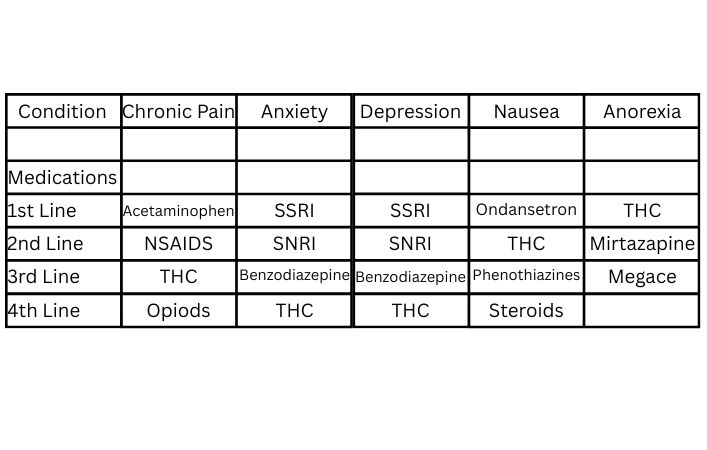 NB: The order above is intended to show relative efficacy and safety. However, it should be noted that THC-dominant cannabis products are safe to use concomitantly with all of the other listed medications.
Nausea and Vomiting
Even for nausea, for which cannabis is renowned for treating, cannabinoids should not be first-line. Ondansetron is similarly effective with fewer side effects. However, in cases where Ondansetron is not sufficient, cannabis should be second-line due to high efficacy and low risk compared to other options like phenothiazine medications.
Appetite Stimulation
Appetite stimulation is an area where conventional medications are simply not good. Cannabis, on the other hand, is quite successful. In this case, cannabis should be first-line therapy over mirtazapine or megace.
Insomnia

Insomnia is another condition for which conventional medications are hit-or-miss. Certain medications like diphenhydramine, trazadone, or melatonin can be helpful and are generally low-risk. Other medications like zolpidem, benzodiazepines, anti-psychotics, or tricyclic antidepressants can work, but are higher risk. Low-dose cannabis can be very effective and likely should be tried after the first group but before the second6. It’s also noteworthy that high-dose cannabis can be disruptive to REM sleep and should be avoided7.
A Note About Other Cannabinoids
The discussion in this article focuses on THC or THC-dominant products for which there are decades of both safety and efficacy data in humans. Other cannabinoids, such as CBD, CBN, CBG are readily available and being actively researched. However, human evidence for their utility is either insufficient (as is the case for CBN and CBG) or inconclusive (as is the case for CBD) at present.
The major exception to this statement is the use of pharmaceutical CBD (Epidiolex) for seizures in children with Dravet’s, Lennox-Gastaut, and Tuberous Sclerosis syndromes, for which the evidence is irrefutable. Nonetheless, there are not data yet to inform where Epidiolex should fall in the choice among other Anti-Epileptic Drugs (AED).
Ultimately, the point here is that cannabinoid medications do work if use appropriately and need to be understood in context of various therapeutic options for each condition. In many instances cannabis is not first-line, but in most instances should not be overlooked nor relegated to last-choice either.
References:
- Dowell D, Ragan KR, Jones CM, Baldwin GT, Chou R. CDC Clinical Practice Guideline for Prescribing Opioids for Pain —United States, 2022. MMWR Recomm Rep 2022;71(No. RR-3):1–95. DOI: http://dx.doi.org/10.15585/mmwr.rr7103a1.
- Jeddi, H. M., Busse, J. W., Sadeghirad, B., Levine, M., Zoratti, M. J., Wang, L., Noori, A., Couban, R. J., & Tarride, J.-E. (2024). Cannabis for medical use versus opioids for chronic non-cancer pain: a systematic review and network meta-analysis of randomised clinical trials. BMJ Open, 14(1), e068182. https://doi.org/10.1136/bmjopen-2022-068182
- Bulbul, A., Mino, E. A., Khorsand-Sahbaie, M., & Lentkowski, L. (2018). Opioid dose reduction and pain control with medical cannabis. Journal of Clinical Oncology, 36(34_suppl), 189–189. https://doi.org/10.1200/JCO.2018.36.34_suppl.189
- Furmark, T., Wahlstedt, K., & Faria, V. (2025). Revisiting the SSRI vs. placebo debate in the treatment of social anxiety disorder: the role of expectancy effects, neural responsivity, and monoamine transporters. Frontiers in Psychology, 16, 1531725. https://doi.org/10.3389/FPSYG.2025.1531725/BIBTEX
- Chad Purcell, Chapter 35 - Benzodiazepines and cannabis use, Editor(s): Victor R. Preedy, Vinood B. Patel, Colin R. Martin, Medicinal Usage of Cannabis and Cannabinoids, Academic Press, 2023, Pages 441-448, ISBN 9780323900362
- da Silva, G. H. S., Barbosa, E. C., de Lima, F. R., Barroso, D. C., Paez, L. E. F. E., Guimarães, F. B. de M., Lança, S. B., de Faria, S. B. C., Petrucci, A. B. C., Garbacka, A., & Walsh, J. H. (2025). Effectiveness of cannabinoids on subjective sleep quality in people with and without insomnia or poor sleep: A systematic review and meta-analysis of randomised studies. Sleep Medicine Reviews, 84, 102156. https://doi.org/10.1016/J.SMRV.2025.102156
- Freemon FR. The effect of chronically administered delta-9- tetrahydrocannabinol upon the polygraphically monitored sleep of normal volunteers. Drug Alcohol Depend. 1982;10(4):345–53.