
Safety concerns of cannabinoid vaping products: Analytical gaps and regulatory challenges
Imagine a young adult reaches for a cannabinoid vape pen (e.g., CBD, CBG, Δ⁹-THC, Δ⁸-THC) before a stressful exam, hoping it will calm their anxiety. Another patient takes a quick puff for fast relief from chronic pain or insomnia.
The appeal is easy to understand — cannabinoid vapes work within minutes and can be used almost anywhere, without drawing much attention. But behind these easy-to-use devices lies an unsettled question: how safe are these products, really?
The risks often stem not only from the cannabinoids themselves, most of which are novel and have no safety data, but also from the solvents, additives, and devices that deliver them.
Unknown risks of novel cannabinoids
Beyond CBD and Δ⁹-THC, emerging cannabinoids such as CBG, CBC, Δ⁷-THC, Δ¹⁰-THC, and HHC are increasingly appearing in vape products. These compounds are largely untested in humans, with no established toxicology or long-term safety data. Chronic exposure to these poorly studied cannabinoids could carry unforeseen risks, including oncogenesis (causing cancer) and teratogenesis (causing birth defects). Many are semi-synthetic, produced from hemp-derived CBD, and may contain harmful contaminants like residual reagents or byproducts from incomplete purification [14,15].
Safety Concerns in Cannabinoid Vaping
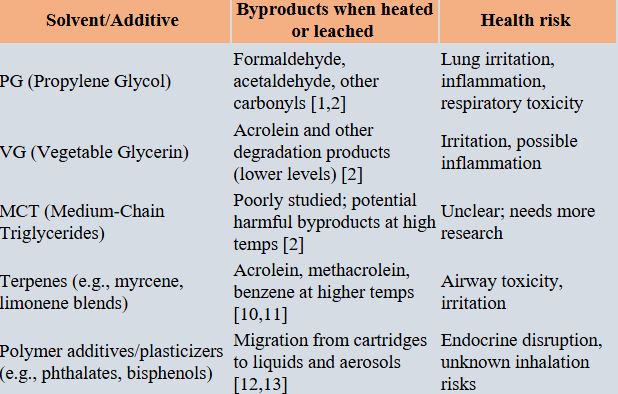
- Carrier solvents (PG, VG, MCT): Most cannabinoid vape liquids use PG, VG, or MCT. When heated, these can break down into toxic compounds such as formaldehyde, acetaldehyde, and acrolein [1,2].
- Terpene-based diluents: Increasingly marketed as “natural” solvents, terpenes can degrade during vaping into acrolein, methacrolein, and benzene, posing respiratory and cancer-causing risks [10,11].
- Additives and flavorings: Some cartridges include thickeners such as vitamin E acetate, which can decompose into ketene, a highly toxic gas linked to severe lung injury [3].
- Contamination and mislabeling: Independent lab tests show many cannabinoid vapes are inaccurately labeled. Some contain less CBD than advertised, while others test positive for Δ9-THC, semi-synthetic cannabinoids, or even heavy metals [4].
- Polymer leachates: Plasticizers such as phthalates and bisphenols have been detected in e-liquids, and may migrate into aerosols, raising additional safety concerns. [12,13].
- Limited toxicology data: While smoking and oral cannabis have been studied, the long-term effects of inhaling cannabinoid vapors remain poorly understood.
Analytical Gaps
Ensuring the safety of cannabinoid vapes is especially challenging because of major gaps in laboratory testing:
- Inconsistent methods: Labs use GC-MS and LC-MS, but no standardized method exists for cannabinoid vapes [5].
- Stability testing: Few studies examine how vape products degrade with heat, light, or humidity [6].
- Lack of reference materials: Without certified standards for harmful degradation products, labs struggle to provide reliable, reproducible results.
- Unknown byproducts: Unlike nicotine e-liquids, the thermal chemistry of cannabinoid vapes is still largely unexplored.
Regulatory Challenges
- United States: The FDA has not approved any cannabinoid vape products. Oversight is minimal, and products are widely sold online or in smoke shops [7].
- State laws: Some states ban cannabinoid vapes, others allow sales with little quality control.
- International variation: EU countries differ in cannabis rules, with few clear policies for inhaled products [8].
- Hemp-derived semi-synthetic cannabinoids: Products like Δ8-THC, Δ10-THC, and HHC are often synthesized from CBD. Poor purification can leave residual solvents and byproducts, while regulation of these products remains inconsistent [14,15].
- Public health risks: Lack of harmonization leaves consumers vulnerable—similar to the 2019 EVALI outbreak [9].
Moving Forward
- Standardized testing: Develop validated methods for harmful byproducts (including terpene degradation and plastic leachates).
- Transparency: Require clear labeling of solvents, terpenes, cannabinoid content, and third-party test results.
- Harmonized regulations: Establish consistent international standards, with attention to hemp-derived semi-synthetics.
- Clinical research: Conduct long-term inhalation studies on cannabinoid vapes.
Conclusion
Cannabinoid vaping is growing rapidly but remains poorly regulated. Toxic byproducts from solvents and terpenes, leached metals and plastics, contamination, and unknown long-term effects all raise red flags. Until testing standards and stronger regulations are in place, healthcare providers and patients should treat cannabinoid vapes with caution. Researchers must close the analytical gaps, and policymakers must act now to prevent the next vaping-related health crisis.
References:
- Jensen RP, Luo W, Pankow JF, Strongin RM, Peyton DH. Hidden formaldehyde in e-cigarette aerosols. N Engl J Med. 2015;372(4):392–394.
- Wang P, Chen W, Liao J, Matsuo T, Ito K, Fowles J, Shusterman D, Mendell M, Kumagai Y. Characterization of e-cigarette aerosols and implications to human health. PLoS One. 2017;12(2):e0173055.
- Strongin RM. Toxic ketene formation from vaping pyrolysis of vitamin E acetate. Proc Natl Acad Sci USA. 2020;117(12):6349–6350.
- Bonn-Miller MO, Loflin MJE, Thomas BF, Marcu JP, Hyke T, Vandrey R. Labeling accuracy of cannabidiol extracts sold online. JAMA. 2017;318(17):1708–1709.
- Peace MR, Butler KE, Wolf CE, Poklis JL, Poklis A. Evaluation of two cannabidiol formulations for e-cigarettes. Front Pharmacol. 2016;7:279.
- Mazzetti C, Ferri E, Pozzi M, Labra M. Quantification of cannabidiol in e-liquids and their stability. Sci Rep. 2020;10:3697.
- U.S. Food and Drug Administration (FDA). Regulation of cannabis and cannabis-derived products. Updated July 16, 2024. Available at: https://www.fda.gov
- Franco V, Bialer M, Perucca E. Current legislation on medical cannabis in the EU. Pharmaceutics. 2023;15(5):635.
- CDC. Outbreak of lung injury associated with e-cigarette or vaping products (EVALI). Updated Feb 2020. Available at: https://www.cdc.gov/tobacco/basic_information/e-cigarettes/severe-lung-disease.html
- Meehan-Atrash J, Luo W, Strongin RM. Toxicant formation in dabbing: The terpene story. ACS Omega. 2017;2(9):6112–6117.
- Tang X, et al. Emissions from heated terpenoids in cannabis products. J Anal Toxicol. 2021;45(8):850–859.
- Wei B, O’Connor RJ, Goniewicz ML, Hyland A. Emerging Chemicals of Health Concern in Electronic Nicotine Delivery Systems. Chem Res Toxicol. 2020;33(10):2637-2646. doi:10.1021/acs.chemrestox.0c00281
- Kubica P, et al. Comparative study of bisphenols in e-cigarette liquids. Chemosphere. 2025;354:148984.
- Ray CL, et al. Delta-8 THC product impurities. Clin Toxicol. 2022;60(7):851–858.
- U.S. Food and Drug Administration. Warning Letters for Cannabis-Derived Products (including cannabidiol (CBD) and delta-8 tetrahydrocannabinol (delta-8 THC) products). FDA, News & Events – Public Health Focus. Published September 3, 2025. Available at: https://www.fda.gov/news-events/public-health-focus/warning-letters-cannabis-derived-products